











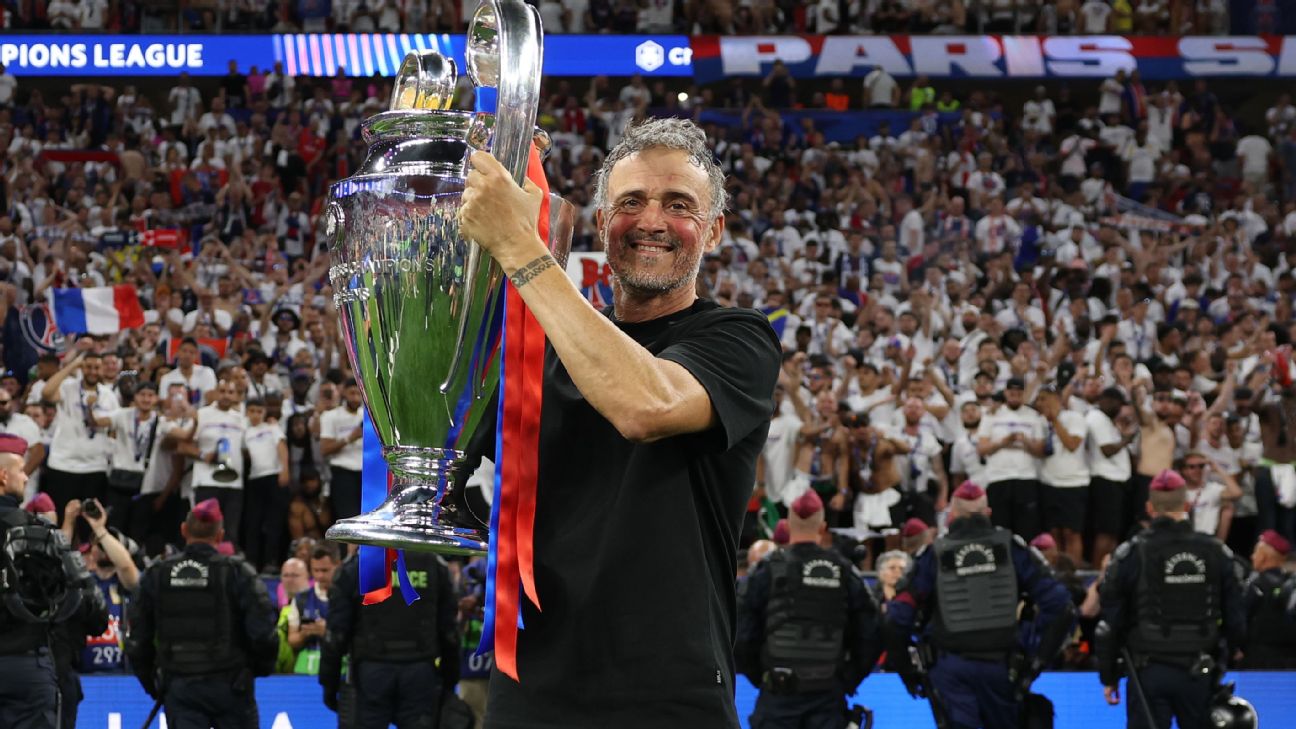
Paris Saint-Germain’s back-to-back UEFA Champions League titles have firmly established their PSG Champions League dominance as the benchmark every club is now measuring itself against. Their win over Arsenal in Budapest — penalties aside — was comprehensive in every sense. Not just the chances created in the final itself, but the entire journey to get there. So what does it actually tell us about where football is heading?
PSG Champions League Dominance Built on a Unique Footballing Blueprint
Luis Enrique’s system is, in many ways, the purest expression of what modern clubs are chasing. A fluid 4-3-3, a two-footed centre-forward who drifts across the front line, and a squad that can shift from blistering counter-attack to suffocating control within the same passage of play. His players carry creative licence — but only in the right moments and the right spaces. It stays a choir, not a poetry slam. That balance is devilishly difficult to achieve.
Furthermore, Luis Enrique himself is unlike almost any other top-level coach working today. He genuinely does not care what the media, supporters or even his bosses think of his decisions. That psychological armour makes him central to the entire sporting project at Parc des Princes — something you simply cannot imagine at Bayern Munich, Liverpool, or Real Madrid. He reportedly earns more than his own players. The club built this around him deliberately.
The pivot away from the galáctico era of Lionel Messi, Neymar, and Kylian Mbappé towards a younger, more malleable group was not purely a footballing call — cost-cutting played its part. But it handed Luis Enrique exactly the piece of clay he wanted. The results speak for themselves. Declan Rice spoke passionately after the final, but this was PSG’s night and nobody could argue otherwise.
The Conditions That Make PSG Hard to Copy
However, let’s be honest about the context here, because it matters enormously. PSG operate in an 18-team Ligue 1 with a budget that dwarfs every rival in the division. That allows them to cruise through domestic weekends at half-throttle and save their peak form for Europe. No Premier League or LaLiga club has that luxury. Indeed, they needed a stoppage-time goal just to avoid defeat against Tottenham Hotspur — who nearly suffered relegation — in last August’s UEFA Super Cup. For the second season running, they also had to come through the Champions League playoff rounds. The road was not always smooth.
Commercially, PSG are similarly remarkable. According to BBC Sport, elite clubs are increasingly judged as global brands as much as football clubs, and PSG have mastered that game. Football Benchmark data shows they generate over €160 per seat per match at the 48,000-capacity Parc des Princes — more than one and a half times what Arsenal pull in at the Emirates. They achieve this without the weekly exposure of the Premier League, without a stadium above 48,000 seats, and without a century of heritage to sell.
Yet somehow they also remain rooted in place. Ici c’est Paris — This is Paris — is plastered everywhere inside the ground. The Eiffel Tower sits in their badge. They leverage their city’s identity more aggressively than almost any club on earth, and to their home supporters, it feels completely genuine. Threading the needle between global brand and local soul is the hardest act in modern football. PSG do it better than anyone.
Ultimately, there is plenty to admire and learn from what PSG have constructed. But replicating it wholesale? That is a different question entirely — and most clubs would need a very different set of circumstances to even come close.